
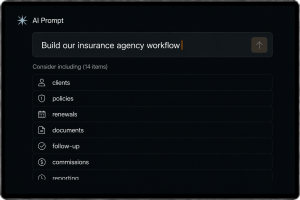
Building Is Easier. Owning Is Different.
AI has made it easier than ever for agents, brokers, and agency owners to imagine building their own insurance agency workflow software.
That is not a bad thing. In fact, experimenting can be useful. A rough internal system can show where renewals get lost, where client notes disappear, where follow-up depends too much on memory, and where the agency's actual process is different from the process everyone thinks exists.
But there is a line worth noticing.
At some point, the software is no longer just a side project. It becomes the place your agency depends on for clients, policies, renewals, documents, commissions, and handoffs. That is when the question changes.
The question is no longer just: Can we build this?
A better question is: Do we want to own what comes after?
Because at the end of the day, you are running an insurance agency. You are not trying to become a software company, an IT department, a testing team, and a support desk on top of everything else.
Building Can Teach You Something
There are real reasons an agency owner might want to try building something. Maybe the current process is scattered across spreadsheets, inboxes, shared folders, calendars, and memory. Maybe the larger agency systems feel too heavy for where the business is today. Maybe the owner has a very specific way they want the agency to work, and the idea of shaping software around that process is appealing.
That instinct is understandable.
Trying to build a simple system can force useful conversations. The process can bring practical questions to the surface. What information should be visible before a client call? Which renewal dates matter most? A CSR may need access to details without asking the producer. Documents need a clear home. The agency also has to decide what counts as complete and what the owner actually wants to measure.
Those are not bad questions. They are the right questions.
The risk is not in asking them. The risk comes when the first answer becomes the system everyone depends on.
AI Can Follow Instructions. Your Business Model Is Harder.
This is the part that often gets underestimated.
AI is good at direct, explicit tasks. Add a field. Create a form. Draft an email. Generate a table. Write a script. Turn this note into a checklist. Those requests have a clear beginning and a clear output.
Agency software is different because the hard part is not always the screen. The hard part is the business model behind the screen.
Every agency has its own way of thinking about service, follow-up, retention, producers, CSRs, renewals, commissions, carrier relationships, and client expectations. Some of that is written down. A lot of it is not. It lives in judgment, habit, experience, and the owner's sense of what matters.
To build software around that, someone has to explain the business in enough detail for the system to make sense. Not just the fields, but the logic. Not just what happens most of the time, but what should happen when the normal path does not apply. Not just what the agency does today, but where the owner wants the business to go.
That takes time.
Describing the work takes time. So does noticing what was left out. Testing may reveal that the system behaves differently than expected. One small change can affect three other parts of the workflow. Even then, the same idea may need to be explained again because the first version was close, but not quite right.
AI can help with that process. It can speed up parts of it. But it does not remove the work of translating an agency's operating model into software.
That translation is where many projects get heavier than expected.
The First Version Is Not Where the Cost Shows Up
The first version usually feels like progress, and often it is. A screen appears. A list gets created. A renewal date can be tracked. A task can be marked complete. Compared with the spreadsheet or notebook that came before it, the new system can feel like a real step forward.
But the first version is rarely where the real cost shows up.
The real cost shows up when the software has to live inside the agency's day-to-day work. A producer is out and someone else needs the latest client note. A policy document changes. A renewal date moves. A carrier asks for something that does not fit the original workflow. A new employee needs training. A commission arrangement changes. A client has multiple policies across multiple carriers. A task gets missed because one part of the system was not connected to another.
None of that is unusual. That is normal agency life.
A small internal system can handle some of it for a while. But as soon as people start trusting it, the expectations change. The software now has to support ownership, status, access, history, continuity, and follow-up. It has to make sense to someone other than the person who built it. It has to keep working when the agency is busy, not just when someone has time to adjust it.
That is the quiet shift. A helper becomes load-bearing before anyone formally decides that it should.
The Cost Is Not Just the AI Subscription
It is tempting to compare a software subscription against the visible cost of an AI tool and assume the AI path is cheaper.
That comparison is too narrow.
The real cost of building your own agency software includes the subscription, but it also includes the hours spent explaining the workflow, revising prompts, testing the output, correcting assumptions, fixing broken logic, documenting what was built, and making sure the next person can use it without guessing.
Ongoing ownership adds another layer: maintenance, updates, backups, permissions, security, training, and support.
Some of those costs never arrive as one clean invoice. They show up as interruptions, late nights, rework, uncertainty, and the nagging feeling that one person has to keep babysitting the system so everyone else can use it.
That does not mean building is always more expensive. It means the comparison should be honest.
A predictable software subscription may not feel as exciting as building something yourself. But if it replaces hours of setup, testing, maintenance, support, and tool-stacking, the economics may be closer than they look at first glance. In some cases, the subscription may be competing less with the cost of AI and more with the cost of becoming your own software team.
Security Is Not Just a Technical Detail
Security can feel like something to worry about later, especially when the system starts as a small internal project.
But insurance agencies handle sensitive information. Depending on the line of business, that may include financial details, household information, business records, policy documents, personal information, and other nonpublic information.
Once real client data is involved, access control, authentication, data handling, backups, and updates are no longer side details. They are part of the responsibility of owning the system.
The OWASP Top 10 is widely used as an awareness standard for critical web application security risks, including issues such as broken access control and security misconfiguration. The NAIC Insurance Data Security Model Law was created to establish standards for data security, investigation, and notification related to nonpublic information in the insurance industry.
That does not mean every agency owner needs to become a security expert before experimenting. It does mean that if an internal system becomes the place where client and policy information lives, the agency should be clear-eyed about what it is now responsible for.
A Good Experiment Can Still Reach Its Limit
There is nothing wrong with a system that helped for a season.
Maybe it moved the agency away from a scattered spreadsheet. Maybe it helped the owner see renewals more clearly. Maybe it made follow-up easier to track. Maybe it forced the team to think through what information really matters.
That can be a successful experiment.
The issue is recognizing when the experiment has reached its limit. A system built for one person may not work as well for five. What fits one line of business may not fit another. Today’s process may also struggle when the agency adds producers, carriers, staff, or reporting needs. If the system was built quickly, the documentation may not be strong enough to maintain it later.
That does not mean the agency was wrong to try. It may simply mean the agency learned enough to know what it needs next.
Where Purpose-Built Agency Software Fits
This is where purpose-built agency software can make sense.
That does not mean every internal system is a mistake. AI still has a place. It also does not mean every agency needs the largest platform it can find.
Purpose-built software becomes more valuable when the agency no longer wants to own every part of the foundation itself.
A platform like CaptaIMS is designed around the daily work of independent agents, brokers, and growing agencies: clients, policies, renewals, documents, follow-up, team visibility, and the structure needed to keep work from living in separate spreadsheets, scattered notes, or one-off internal systems.
The value is not only the feature list. The value is that much of the foundation has already been built, tested, organized, and maintained, so the agency can spend more time on the book of business and less time managing the system behind the system.
At some point, the practical question is not whether AI can help build something. It can.
The question is whether building and owning that software operation is the best use of the agency's time, attention, and budget.
AI Still Has a Place
AI will continue to be useful for agencies.
It can help draft client emails, summarize information, organize ideas, create training material, and help an owner think through parts of the workflow that used to stay stuck in someone's head. Agencies should not ignore that.
The question is where AI fits best.
There is a difference between using AI to improve pieces of the work and relying on an AI-assisted build as the long-term system of record for the agency. Both can have value. They are just not the same decision.
The Better Question
Before building your own agency software, the best question may not be: Can we build this?
With today's tools, the answer may be yes.
A better question is, If this works, are we ready to own it?
That question changes the conversation. It makes room for experimentation without ignoring responsibility. It lets an agency learn from building without assuming the first version has to carry the business forever.
For some agencies, building a simple internal system may reveal exactly where the current process is breaking down. That can be useful.
But if the system starts carrying real clients, policies, renewals, documents, commissions, and follow-up, the decision changes. The agency is no longer just testing an idea. It is now responsible for the software operation behind the work.
At that point, it is worth asking whether the agency wants to keep building and maintaining the foundation itself, or whether that energy is better spent writing, servicing, and growing the book.
If your agency has already outgrown spreadsheets, shared folders, or a system that started as a quick experiment, CaptaIMS may be worth a closer look.
Visit CaptaIMS to learn more about practical insurance agency workflow software for independent agents, brokers, and growing agencies.